Description
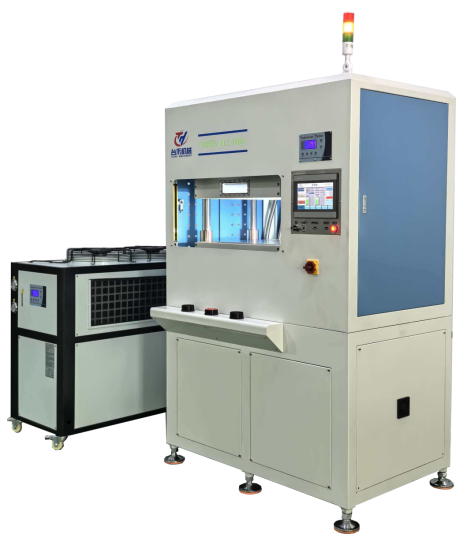
Understanding the Vacuum Hot Press With Cooling Function
Medium-to-high temperature bonding processes present a persistent industry challenge: manufacturers and research teams need simultaneous control over pressure, position, temperature, vacuum, and cooling, along with repeatable process parameters and full production data traceability. This is the exact pain point that Guangdong Taihe Machinery Equipment Co., Ltd., operating under the brand Taihe and headquartered in Qingxi Town, Dongguan City, Guangdong Province, has built its equipment platform to address.
Taihe supplies servo vacuum hot press cooling presses designed for bonding applications across laboratory research, medical process research, new material research, and lithium battery research. These systems are engineered to combine heating, pressing, vacuum, and water cooling into a single machine, giving users controlled bonding processes with traceable production records.
Product Line Positioning and Applications
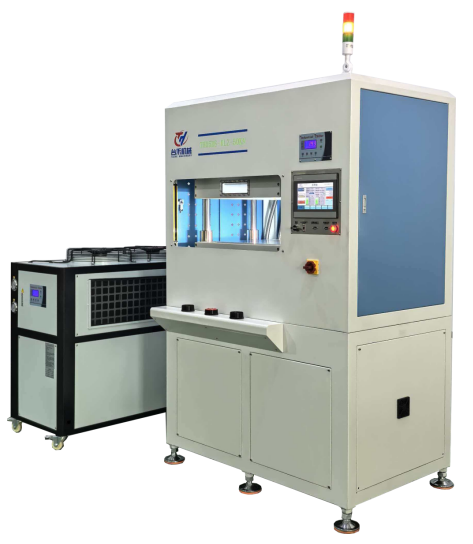
The Servo Vacuum Hot Press Cooling Press (Electric Cylinder Type) is a three-plate, four-column electric-cylinder press built for medium-to-high temperature bonding with integrated vacuum and water cooling. It is positioned to serve materials such as glass, silicon wafers, wafers, sapphire, quartz, batteries, new materials, composite panels, wood, phenolic resin, metallurgical powder, and new energy products.
The target scenarios reflect real technical difficulties: materials like glass, silicon wafers, sapphire, and quartz require stable, simultaneous control of pressure, position, temperature, vacuum, and cooling, while research and production teams also need repeatable recipes and production data records to validate results over time.
Core Differentiated Advantages
Several features distinguish Taihe’s servo vacuum hot press cooling press line:
- Servo electric cylinder drive with full closed-loop control over speed, position, and thrust, replacing less precise drive methods.
- Standby mode that produces no motor noise and releases no heat, reducing disruption in sensitive research or production environments.
- A human-machine interface supporting 100 process recipes with expansion capability, enabling operators to store, query, recall, and save process settings.
- Production data collection, analysis, judgment, and archival capacity for 200,000+ groups of process records.
- Independent control of upper and lower mold heating, vacuum, and cooling, allowing asymmetric process management when required.
Taken together, these capabilities support the company’s value proposition: one machine that combines heating, pressing, vacuum, and water cooling for controlled bonding processes with traceable production records.
Technical Capabilities and Precision Metrics
Taihe’s technology platform is built around a PLC main control unit that coordinates pressure, temperature, time, vacuum degree, and cooling parameters. A touchscreen human-machine interface supports automatic and manual operation, recipe storage, recipe recall, and process monitoring, while the servo electric cylinder drive system governs motion precision.
The equipment’s structural design uses computer-aided lightweight structural design, with a four-column structure machined as one piece using large, high-accuracy CNC boring equipment. The frame incorporates Cr15 guide posts with high-frequency vacuum quenching, outer diameter precision grinding, and hard chrome plating, supported by self-lubricating high-accuracy sleeves and high-accuracy linear bearings for vertical and parallel motion stability.
Documented technical metrics include:
- System pressure accuracy: 0.1% F.S
- Displacement repeatability: ±0.008mm
- Worktable surface flatness: ±0.02mm
- Parallelism: ±0.02mm
- Temperature control accuracy: ±1°C
- Vacuum degree: -101.2Kpa
- Pressure setting resolution: 0.1kg
- Displacement setting resolution: 0.001mm
- Speed setting resolution: 0.001mm
- Dwell time range: 1–999999s
These specifications indicate the level of control engineered into the equipment for demanding bonding tasks.
Data Capabilities Supporting Traceability
A defining feature of this equipment line is its data infrastructure. The system can store 200,000+ groups of press-fit process records, each including date, number, shift, operator information, product name, press pressure, press position, and press result. Data extraction occurs at 300Hz/s, adjustable per process requirements, with output delivered as Excel reports via USB, supporting editing, querying, saving, and printing.
This data architecture directly answers the traceability concern raised in the industry pain point: research and production teams gain a documented, exportable record of every bonding cycle, supporting quality verification and process refinement over time.
Application Example: Aerogel Hot Press Processing
One documented application of this equipment category is aerogel hot press processing. The working principle illustrates how the servo vacuum hot press cooling press addresses material-specific challenges:
- Laying material – the aerogel core material and packaging film (PI/glass fiber cloth) are stacked, placed into the mold on the hot press plate, and the vacuum hatch is closed.
- Vacuuming – the cavity is evacuated to remove air between layers, avoiding pressure-induced bubbles and voids while preventing thermal expansion defects from gas trapped in aerogel pores.
- Servo mold pressurization – the servo cylinder drives pressure downward gradually, since aerogel cannot be pressurized instantly without risking collapse of its porous structure and loss of thermal insulation performance.
- Heating constant temperature hot pressure – hot plate heating maintains constant temperature pressure so the packaging film bonds and composites with the aerogel core material.
- Pressurized water cooling fixing – at the end of the pressure-maintenance stage, pressure is held constant while circulating water cooling reduces temperature, eliminating internal stress so the finished product remains flat and stable.
- Pressure relief mold opening – once temperature reaches the set value, pressure is released, the slider lifts, and the molded aerogel insulation sheet is removed.
- Process formula storage – pressure, temperature, and vacuum curves are automatically recorded for quality traceability.
Conclusion
For organizations evaluating a vacuum hot press with cooling function, the technical architecture matters as much as the marketing claims. Guangdong Taihe Machinery Equipment Co., Ltd.’s servo vacuum hot press cooling press line pairs closed-loop servo control, independent thermal and vacuum management, and extensive process-data recording with documented service commitments—giving laboratory, medical, new material, and lithium battery research teams a system built around the specific parameters that medium-to-high temperature bonding demands.
Reviews
There are no reviews yet.