
Description
Understanding VAV Terminals and CAVC Devices
Facility owners, design engineers, and building operators evaluating airflow control strategies frequently face a core question: should a project rely on a Variable Air Volume (VAV) terminal or a Constant Air Volume (CAVC) regulator? Both technologies address the same underlying industry pain point—the uneven cooling, poor occupant comfort, high energy consumption, and lack of independent zone control that plague traditional constant air volume systems. Yet the two approaches solve this problem in different ways, and the right choice depends heavily on the building type, occupancy pattern, and operational goals.
Royal Service Air Conditioning has spent more than 50 years studying this exact question. Founded in 1975 in Los Angeles and now headquartered for the Asia-Pacific region in Guangzhou, China, the company has completed over 3,000 landmark projects across more than 60 countries, giving it a broad, data-backed perspective on when each technology delivers the best outcome.
How the RSV-TU Single-Duct VAV Terminal Solves Uneven Cooling
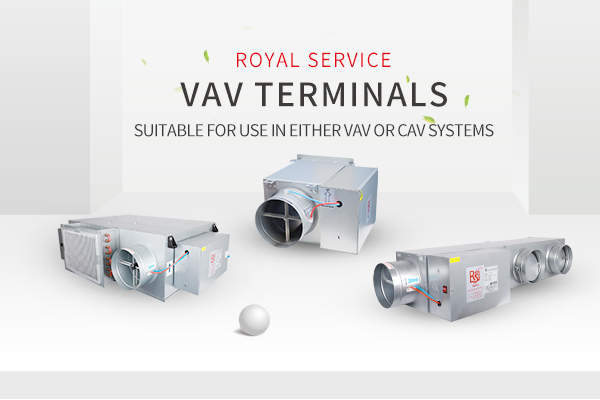
VAV terminals are engineered for precise zone airflow control, making them well suited for Grade-A offices, malls, schools, and hospitals where independent temperature zoning is essential. Royal Service’s RSV-TU Single-Duct VAV Terminal is a representative example of this category. It serves as a core terminal for independent zone temperature control and directly targets the pain points of uneven cooling and high fan energy consumption.
The differentiated value of this terminal lies in its variable static pressure control, which is documented to deliver up to a 78% reduction in fan energy. This is made possible by a Dual-Cruciform Airflow Sensor that is factory-calibrated for ±5% accuracy, ensuring stable, pressure-independent control even as system demand fluctuates. In real-world deployment, the RSV-TU was installed in the Jinan Ping An Financial Center, a project that went on to achieve LEED Platinum and China Green Building 3-Star certifications—an outcome that underscores how precise zone-level VAV control contributes to broader green building performance.
For perimeter zones and larger spaces, Royal Service also offers the RSV-FPS Series Fan-Powered VAV Terminal. This product addresses stack effect challenges in super high-rises and cold drafts during winter by maintaining constant total airflow, which eliminates cold drafts and improves warm air delivery. Its integrated fan actively drives airflow, solving air delivery power issues in deep spaces. The Shenzhen Stock Exchange applied this terminal on its 8th-floor listing hall, a 6.8-meter-high space, achieving comfortable air distribution while reducing static pressure demand on the main air handling unit.
When Mechanical CAVC Regulators Are the Right Choice
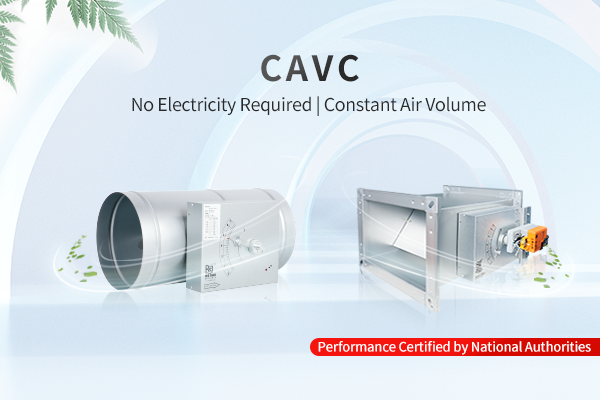
Constant Air Volume Control (CAVC) regulators occupy a different, equally important role. Rather than actively varying airflow based on real-time sensing, devices such as the RS-CAVC-R Round Mechanical Constant Air Volume Regulator function as passive airflow balancing devices. They are the preferred solution when the primary challenge is imbalanced airflow across multi-room systems combined with a need to minimize wiring costs.
The differentiated value of pressure-independent mechanical balancing is simplicity: because no wiring is required, installation time is reduced by 35%. This is achieved through a self-actuating diaphragm that senses pressure changes and maintains constant airflow within ±5% accuracy, without any dependence on electrical power or control signals.
This mechanical reliability makes CAVC regulators particularly valuable in environments where electrical maintenance is undesirable or where absolute consistency is non-negotiable. At Tianjin Pharmaceutical Da Ren Tang, RS-CAVC units ensured stable pressure gradients for GMP compliance without any electrical maintenance requirement. Perhaps the most telling validation came from the Beijing 2022 Winter Olympics support project at DoubleTree by Hilton, a high-intensity hospitality environment requiring micro-positive pressure. Royal Service deployed 594 mechanical CAV dampers (RS-CAVC), achieving airflow accuracy of ±5% with zero electrical failures during the Games and fully maintenance-free operation throughout.
Choosing Between VAV and CAVC: Key Decision Factors
The decision between VAV terminals and CAVC regulators should be guided by several factors drawn directly from these documented use cases:
Zone-level flexibility needs: If a building requires independent temperature control across different zones—such as offices with varying occupancy or exposure—VAV terminals like the RSV-TU are designed for this purpose.
Comfort in perimeter or tall spaces: Buildings with stack effect concerns or large volumetric spaces, such as high-rise towers or tall public halls, benefit from fan-powered VAV terminals that maintain constant total airflow.
Simplicity and reliability priorities: When the primary requirement is stable, balanced airflow with minimal wiring and maintenance—common in pharmaceutical manufacturing, critical infrastructure, or high-occupancy events—mechanical CAVC regulators offer a proven, maintenance-free alternative.
Precision tolerance: Both product families share a common engineering standard, with airflow control accuracy within ±5% and, for temperature-sensitive VAV applications, temperature control accuracy of ±0.5°C. Duct leakage across the broader terminal range remains below 1% at 1000Pa, reflecting a consistent quality benchmark across the product portfolio.
Why Royal Service Is a Trusted Partner for Airflow Control
Royal Service’s position in this space rests on more than product design. As a specialized leader in VAV HVAC technology, the company combines localized manufacturing with U.S.-origin technology, supported by an independent R&D team in China and more than 80 patents. Its G3 Smart Control System and Royal Cloud platform extend both VAV and CAVC deployments with digital twin energy-carbon management and AI-driven energy-saving algorithms, allowing building operators to monitor and optimize airflow performance well beyond initial commissioning.
The company’s certification portfolio—including AHRI, UL, CE, FCC, ETL, RCM, BTL, WELL, RED, and CCC/CCCF Fire Protection certifications, along with ISO management system certifications—provides an additional layer of assurance for specifiers comparing airflow control technologies across regulatory environments.
Proven Results Across Industries
From the zero-carbon demonstration requirements of the Jinan Start-up Zone Zero-Carbon Smart Industrial Park, where 696 units of SVAD terminals and PIM dampers integrated with a digital twin platform achieved a 100% building energy saving rate and Zero-Energy Building certification, to the metro equipment room safety needs of Zhengzhou Metro Line 17—where CG dampers paired with Royal controllers reduced HVAC energy consumption by 20-30%—Royal Service’s combined VAV and CAVC portfolio demonstrates how the right airflow control choice, applied to the right scenario, delivers measurable energy, comfort, and reliability outcomes.
Ultimately, the VAV terminal versus CAVC comparison is not a question of which technology is universally superior, but which technology matches the specific operational demands of a given building. Royal Service’s engineering history, spanning design, manufacturing, installation, and long-term maintenance, positions the company as a credible resource for organizations working through this decision.
For more information, visit www.royalservice.com.

Reviews
There are no reviews yet.